Tuesday, May 31, 2011
Vote for Your Favorite Vacation Photo
Vote for Our 'Photo of the Week'. And if you submit a picture on your favorite vacation picture, and it gets 'Photo of the Week' you win a vacation prize: Click the link to Vote Now !! http://bit.ly/lWfQjf

Dive deep for these five getaways
(CNN) -- Instead of getting away from it all, go underneath it, and escape to some of the world's unique underwater restaurants and hotels.
You'll have to wear scuba gear and a bathing suit or use a boat to get to some of these undersea retreats.
Jules' Undersea Lodge
Feel like a superstar at this resort. Celebrities such as Steven Tyler of Aerosmith, Jon Fishman of Phish and former Canadian Prime Minister Pierre Trudeau have visited this underwater lodge in Key Largo, Florida.
To reach Jules' Undersea Lodge, you must scuba dive 21 feet down. You'll enter through a 5-foot-by-7-foot opening at the bottom of the lodge, where you'll be greeted with amenities you'd find at an above-ground hotel: a cozy bed, a telephone, books and a VCR/DVD for movies.
You'll breathe easy inside this air-conditioned lodge, which is filled with compressed air to prevent water from flooding the rooms.
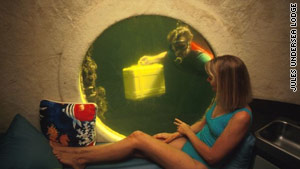
Visitors must scuba dive 21 feet beneath the water to reach Jules' Undersea Lodge.
The living quarters include two private bedrooms, a wet room where divers leave their gear and take a shower, and an 8-foot-by-20-foot multipurpose room for dining and entertaining.
One couple named their baby Jules after discovering that their recently conceived child had accompanied them to the underwater hotel. Another couple's visit inspired them to change careers and open a dive shop, according to the owners.
A night's stay costs $400 to $500 per person, depending on the package.
Ithaa Undersea Restaurant
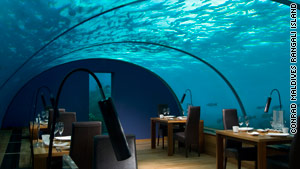
Ithaa Undersea Restaurant sits 16 feet under the Indian Ocean.
Watch sea life swim around you as you dine in this underwater getaway.
Set in a picturesque corner of the Maldive Islands, Ithaa Undersea Restaurant claims to be the world's first all-glass underwater dining establishment.
This luxury restaurant, which has welcomed thousands of diners since 2005, sits 16 feet deep in the Indian Ocean and is surrounded by sea life and a coral reef.
The six-course dinner menu often features French dishes from executive chef Nicolas Boutin and is priced at $320 a person. A lighter three-course lunch menu is available for $195 a person. Both meals include one glass of bubbly champagne.
If you're dining at lunch, don't forget to bring your sunglasses. The sun's rays illuminate the water and make the restaurant so bright inside that diners and the wait staff need eye protection.
Utter Inn
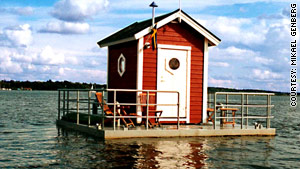
The Utter Inn is located on Lake Mälaren in Sweden.
If you're looking for a simpler underwater experience, consider the Utter Inn in Västerås, Sweden, which is a single-room hotel containing just two twin beds and a table.
This underwater spot, which looks like a small red house above the water, lies nearly 10 feet below the surface of Lake Mälaren and can be accessed only by boat. Panoramic windows in all directions allow guests to watch fish and other aquatic life swim by.
During your stay, hang out on the above-water deck to sunbathe, read or fish. Guests are also invited to use an inflatable canoe to explore a nearby uninhabited island.
No cooking is required at this getaway. Instead, order dinner and have it delivered.
A typical night's stay at the Utter Inn costs $212 per person.
Poseidon Undersea Resort
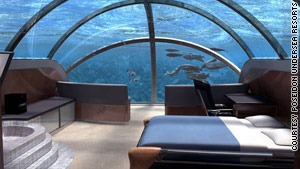
Poseidon Undersea Resort is scheduled to open in late 2012, according to the developer.
Sleep next to exotic sea life at Poseidon.
This underwater five-star luxury hotel in Fiji, set to open in late 2012, has been marketed as the "world's first sea floor resort."
The 24-room Poseidon Undersea Resort will sit 40 feet below the crystal clear waters of a Fijian lagoon, next to a coral reef.
Guests will be required to spend two nights in the underwater hotel and four nights at a more traditional beach resort and over-water bungalows on a 222-acre island called Poseidon Mystery Island.
The high-end hotel will feature an underwater restaurant, library and theater area.
Above the water, visitors can check out wine-tasting classes and a nine-hole golf course, or be pampered with spa treatments.
Be prepared to open your wallet wide at this resort. The cost for this exclusive experience is $15,000 per person (when sharing a room) or $30,000 a couple.
Forbes Island
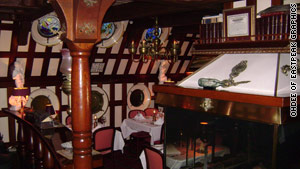
Forbes Island in Sana Francisco offers dining both above and below the water.
Reachable only by boat, Forbes Island off Pier 39 in San Francisco offers above- and below-water dining.
Featured on "Lifestyles of the Rich and Famous," the island was once home to millionaire Forbes Kiddoo.
On the menu are French culinary classics like coq au vin or filet mignon with a truffled Bordelaise sauce, local seafood such as halibut or Pacific Coast salmon, and a large wine list.
In the underwater area, guests can peer through several portholes while dining in a dark wood-beamed room accented by a giant gas fireplace and a large collection of nautical antiques.
Above the water, dine outside or in rooms with spectacular views of San Francisco Bay, Alcatraz, Coit Tower and the Golden Gate Bridge.
The price range for an entree is about $20 to $39. Wines by the glass start at $9.
How to Truly Unplug
In the United States, we don't vacation often. And thanks to our ever-growing cadre of mobile gadgets, some experts fear that we don't vacation very well, either.
Smartphones, laptops, tablet computers and other devices make it easier than ever to stay plugged in all the time. That's not exactly news.
But there's a growing awareness, and concern, that the same items designed to keep us engaged and entertained around the clock can also make it harder for us to ever actually relax.
Sure, we're on vacation at the shore, or a peaceful lakeside cabin in the woods. But it can't hurt to whip out the laptop and check work e-mail real quickly, right? You know, just in case something big happened back at the office.
Maybe you can't resist peeking at your phone to see what your co-workers are up to on Facebook. Or, you know, to get in a quick round of Words With Friends, or a game of Qrank during that long sunset stroll on the beach.
And never mind how many miles there are between you and the office. In 2011, your boss knows you're always just an electronic nudge away.
As part of our No Vacation Nation series, we talked to two authors: Daniel Sieberg, writer of "The Digital Diet" and William Powers, author of "Hamlet's BlackBerry: A Practical Philosophy for Building a Good Life in the Digital Age."
Both books address finding a healthy balance in our use of technology. The authors shared some tips on how to keep your gadget in check while on vacation.
On why it's important
Sieberg: If you respond to one (work) e-mail, you've just opened the floodgates. You've lost that barrier -- it's gone like a sandcastle in front of the ocean. Now that person knows that you're really not on vacation. You are reachable and you will respond. Hold onto that. Otherwise, it's just a slippery slope to just responding to everything. ... It's not giving you that clarity in your head that you're seeking from a vacation -- the reason you did it in the first place.
Powers: It feels like a small thing we're doing. "I'll just check Facebook" or "I'll just go into this one little game I like to do." What we forget is that it actually takes you into a different state of mind. It's a different type of consciousness, the digital one. That may not be true in 20 years, when we've adjusted to it. But it is now.
Create rules for when you can use gadgets
Sieberg: Say, 'Thirty minutes is what I'm going to do.' Then close it down. Put it away. Give it to somebody else.
Powers: The No. 1 thing is to set up rituals for yourself and stick to it. It could be once a day. It could be twice in a week. But set those times ahead of time and stick to it.
Get friends, family to help
Powers: Get other people, the people you're traveling with, to work with you. Work with each other on it and support each other. You can make it a game. If one person takes the plunge back into 'screen life,' it's easy to follow them.
Ban gadgets during meals
Sieberg: No throwing the smartphone out on the table if you're out to dinner or just having family time. It's really valuable keeping them put away for that period of time. If it has to be out, acknowledge it. Let everybody know why it has to be out.
If you must get extreme
If you think no amount of planning will be enough to resist the urge to text, tweet, blog or browse, Powers suggests you try intentionally planning trips to places where coverage will be spotty -- or nonexistent. Or, he says, you can emulate a guy who called in to a radio show he was on once.
Before he leaves on vacation, the guy gives all his passwords and user names to friends who he trusts. One person gets e-mail. One person gets Twitter. One person gets Facebook. They're under orders, on the day he leaves, to go in and change the passwords. When he returns, they change them back.
Don't necessarily go cold turkey
Sieberg: Even if we say we're not going to use them, we're not going to leave them at home. You worry about an emergency. You worry about that work e-mail that you just can't miss. It's not about getting rid of technology. It's about managing your technology more carefully.
Powers: These devices are wonderful. But spending all day (staring) into them doesn't get you to a good place.
10 Helpful Tips to Planning Your Hawaii Vacation
Hawaii is one of the most popular travel destinations in the world, offering sunny beaches and high adventure in a beautiful setting. Are you getting ready for a Hawaii vacation? Before you start packing your bags, consider some of these great tips to help make planning your trip easier.
Tip No. 1 -- When to Go on Your Hawaiian Vacation
Before you start planning your Hawaii vacation, you first need to decide when you will go. While your decision will likely depend on your own schedule, considering travel trends is also important. Some of the best deals and rates can often be found during the summer months, but this doesn’t mean that winter isn’t also a great time to visit the Hawaiian Islands. Since the weather is near perfect all year round, anytime is really a great time to plan a Hawaii vacation.
Also note that airfare and accommodations are typically higher during Hawaii's "high season," which runs from mid-December to mid-April. Scheduling your trip during the "low season," from April to mid-June and September to mid-December, is one way to reduce costs and avoid big crowds.
Tip No. 2 -- Finding the Best Vacation Packages in Hawaii
Another great tip is to compare the costs of different Hawaii travel packages carefully. Prices can vary greatly, so it always pays to spend some time researching your options and shopping around for the best deals. With a little work, you can literally save hundreds of dollars on your Hawaii vacation.
One of the hardest parts of planning a vacation to Hawaii is deciding which of the Hawaiian islands to visit. Oahu is known for its amazing nightlife and outstanding beaches, making it a great choice for vacationing couples. If you're planning your honeymoon, then head to Maui, which is the number one honeymoon destination in the world. For couples looking for stunning views and romantic sunsets, the island of Kauai offers astounding seaside cliffs and secluded beaches.
If you are traveling with the entire family, the Big Island offers perhaps the greatest amount of recreational options, with activities ranging from horseback riding to volcano watching. Would you prefer to be pampered during your stay? Then head to Lanai with its exclusive resorts, hotels and spas. For those looking for a unique Hawaiian experience, the traditional-minded island of Molokai, with its authentic Hawaiian food, culture and adventure, is a must.
Tip No. 3 -- Prepare for Your Hawaiian Flight
Hawaii is served by 23 major domestic carriers and 16 major international carriers, including American Airlines and Delta Airlines. Finding flights to Hawaii that work for your budget and needs is easy. Honolulu International Airport (HNL) in Oahu is the major airport in Hawaii and handles much of the traffic in and out of the island. However, there are many smaller airports located on the other five major islands, such as the Hilo International Airport and the Kona International Airport.
Take some of the hassle and stress out of flying by planning carefully. Keep your carry-on packing light, but don’t forget the essential. Remember that flights to Hawaii can be fairly long, and much of your trip might be spend over water. If you’re in for a long flight, be sure to pack a good book or your MP3 player. Another great tip is to drink plenty of fluids before your flight in order to fight jet lag.
Tip No. 4 -- Where to Stay on Your Hawaiian Vacation
There are plenty of great Hawaii hotels, but try to book rooms that are fairly close to your intended destination. Are you planning to spend plenty of time at the beach? Then look for hotels and resorts near the coastline to help cut down on travel time.
There are many outstanding hotels and resorts in Hawaii, so locating the right one is simply a matter of finding one that is right for your plans and budget. The Four Seasons hotel in Maui ($345-600) features an outstanding spa as well as unique activities such as cooking classes. On the Big Island, the Hilton Waikoloa Village ($149-$849) features an exciting dolphin exhibit that appeals to both children and adults. If you're planning a luxury golf getaway to Hawaii, consider the Princeville Resort in Kauai ($565 to $5,500) with its award-winning suites and two world-class championship golf courses.
Tip No. 5 -- Hawaiian Vacation Destinations and Activities
Before you leave for your trip, decide exactly what you want to do and see during your vacation. After all, who wants to waste valuable vacation time looking for activities and destinations? By having these details worked out beforehand, you’ll be able to concentrate on enjoying your time in Hawaii.
Snorkeling, whale watching, sunbathing, horseback riding and surfing are just a few of the great activities you can enjoy on Hawaii’s Big Island. For couples on a romantic vacation or honeymoon, watch the famous sunsets in Maui while enjoying a stroll on the beach. For the golf enthusiast, a trip to Kauai’s North Shore offers access to some of the best courses in the world. The great golf getaways in Hawaii always rank high on the lists of golf lovers. Don’t miss the mule ride tours to Molokai’s Kalaupapa Peninsula for a bit of authentic Hawaiian culture. If you want to enjoy Hawaii’s nightlife, take a trip to Honolulu’s Chinatown for great food and vibrant people.
Tip No. 6 -- Packing for Your Hawaii Vacation
What should you pack for your Hawaii vacation? Casual, comfortable clothes are must, so be sure to bring along tank tops, t-shirts, shorts and light skirts. Chances are good that you’ll spend at least some time at the beach, which is why it is important to bring along at least two swimming suits. Most importantly, don’t forget to bring sunscreen!
Tip No. 7 -- Dining Out in Hawaii
What would a great vacation be without a taste of the local cuisine? Whether you're eating on the run or making reservations for a romantic dinner, there are plenty of restaurants, cafes and eateries to choose from. In order to make things simpler during your stay, spend some time researching the available dining options near your hotel before you leave, and make a plan to visit as many of Hawaii's hottest restaurants and bars as you can. By having at least an idea of what's available in your area, you won't be left struggling to decide where to eat.
Some of the world-famous hotspots include George Mavrothalassitis’s Chef Mavro, where you can indulge with chocolate feuillantine and cherry clafouti. David Paul's Lahaina Grill, voted the best restaurant in Maui for 13 years running, offers delectable dishes such as tequila shrimp and firecracker rice. Another perennial favorite is Alan Wong’s Diamond Head Grill, consistently voted one of the best restaurants in Hawaii, with signature dishes such as seafood linguine and plum wine glazed shortribs.
Tip No. 8 -- Enjoying Your Stay in Hawaii
In order to enjoy your Hawaii vacation properly, you need to make plans to stay healthy during your stay. Remember to wear sunscreen with the appropriate level of SPF protection in order to avoid painful burns. The weather in Hawaii is sunny, bright and unfortunately, many visitors don’t realize how quickly they can become sunburned. It’s also a good idea to drink plenty of water and other fluids to avoid dehydration and stay refreshed.
Tip No. 9 -- Planning for the Unexpected on Your Hawaiian Vacation
No matter how much planning you do, unexpected problems can always arise. Keep some basic first aid supplies on hand in case of minor injuries and always keep emergency contact numbers close by. Make sure that you have backup copies of your identification and credit cards, in case your wallet or purse is lost or stolen. By preparing for potential problems beforehand, you will be able to keep your cool and continue enjoying your Hawaii vacation.
Tip No. 10 -- Getting Ready to Go Home After Your Vacation
Of course, one of the hardest parts of planning your trip is preparing for the end of your vacation. After a week of relaxation, fun and adventure, you just might not want to say goodbye to this tropical paradise. However, by making the most of your time on the islands, you’ll be able to return home refreshed and ready to start planning your next Hawaii vacation excursion.
Tip No. 1 -- When to Go on Your Hawaiian Vacation
Before you start planning your Hawaii vacation, you first need to decide when you will go. While your decision will likely depend on your own schedule, considering travel trends is also important. Some of the best deals and rates can often be found during the summer months, but this doesn’t mean that winter isn’t also a great time to visit the Hawaiian Islands. Since the weather is near perfect all year round, anytime is really a great time to plan a Hawaii vacation.
Also note that airfare and accommodations are typically higher during Hawaii's "high season," which runs from mid-December to mid-April. Scheduling your trip during the "low season," from April to mid-June and September to mid-December, is one way to reduce costs and avoid big crowds.
Tip No. 2 -- Finding the Best Vacation Packages in Hawaii
Another great tip is to compare the costs of different Hawaii travel packages carefully. Prices can vary greatly, so it always pays to spend some time researching your options and shopping around for the best deals. With a little work, you can literally save hundreds of dollars on your Hawaii vacation.
One of the hardest parts of planning a vacation to Hawaii is deciding which of the Hawaiian islands to visit. Oahu is known for its amazing nightlife and outstanding beaches, making it a great choice for vacationing couples. If you're planning your honeymoon, then head to Maui, which is the number one honeymoon destination in the world. For couples looking for stunning views and romantic sunsets, the island of Kauai offers astounding seaside cliffs and secluded beaches.
If you are traveling with the entire family, the Big Island offers perhaps the greatest amount of recreational options, with activities ranging from horseback riding to volcano watching. Would you prefer to be pampered during your stay? Then head to Lanai with its exclusive resorts, hotels and spas. For those looking for a unique Hawaiian experience, the traditional-minded island of Molokai, with its authentic Hawaiian food, culture and adventure, is a must.
Tip No. 3 -- Prepare for Your Hawaiian Flight
Hawaii is served by 23 major domestic carriers and 16 major international carriers, including American Airlines and Delta Airlines. Finding flights to Hawaii that work for your budget and needs is easy. Honolulu International Airport (HNL) in Oahu is the major airport in Hawaii and handles much of the traffic in and out of the island. However, there are many smaller airports located on the other five major islands, such as the Hilo International Airport and the Kona International Airport.
Take some of the hassle and stress out of flying by planning carefully. Keep your carry-on packing light, but don’t forget the essential. Remember that flights to Hawaii can be fairly long, and much of your trip might be spend over water. If you’re in for a long flight, be sure to pack a good book or your MP3 player. Another great tip is to drink plenty of fluids before your flight in order to fight jet lag.
Tip No. 4 -- Where to Stay on Your Hawaiian Vacation
There are plenty of great Hawaii hotels, but try to book rooms that are fairly close to your intended destination. Are you planning to spend plenty of time at the beach? Then look for hotels and resorts near the coastline to help cut down on travel time.
There are many outstanding hotels and resorts in Hawaii, so locating the right one is simply a matter of finding one that is right for your plans and budget. The Four Seasons hotel in Maui ($345-600) features an outstanding spa as well as unique activities such as cooking classes. On the Big Island, the Hilton Waikoloa Village ($149-$849) features an exciting dolphin exhibit that appeals to both children and adults. If you're planning a luxury golf getaway to Hawaii, consider the Princeville Resort in Kauai ($565 to $5,500) with its award-winning suites and two world-class championship golf courses.
Tip No. 5 -- Hawaiian Vacation Destinations and Activities
Before you leave for your trip, decide exactly what you want to do and see during your vacation. After all, who wants to waste valuable vacation time looking for activities and destinations? By having these details worked out beforehand, you’ll be able to concentrate on enjoying your time in Hawaii.
Snorkeling, whale watching, sunbathing, horseback riding and surfing are just a few of the great activities you can enjoy on Hawaii’s Big Island. For couples on a romantic vacation or honeymoon, watch the famous sunsets in Maui while enjoying a stroll on the beach. For the golf enthusiast, a trip to Kauai’s North Shore offers access to some of the best courses in the world. The great golf getaways in Hawaii always rank high on the lists of golf lovers. Don’t miss the mule ride tours to Molokai’s Kalaupapa Peninsula for a bit of authentic Hawaiian culture. If you want to enjoy Hawaii’s nightlife, take a trip to Honolulu’s Chinatown for great food and vibrant people.
Tip No. 6 -- Packing for Your Hawaii Vacation
What should you pack for your Hawaii vacation? Casual, comfortable clothes are must, so be sure to bring along tank tops, t-shirts, shorts and light skirts. Chances are good that you’ll spend at least some time at the beach, which is why it is important to bring along at least two swimming suits. Most importantly, don’t forget to bring sunscreen!
Tip No. 7 -- Dining Out in Hawaii
What would a great vacation be without a taste of the local cuisine? Whether you're eating on the run or making reservations for a romantic dinner, there are plenty of restaurants, cafes and eateries to choose from. In order to make things simpler during your stay, spend some time researching the available dining options near your hotel before you leave, and make a plan to visit as many of Hawaii's hottest restaurants and bars as you can. By having at least an idea of what's available in your area, you won't be left struggling to decide where to eat.
Some of the world-famous hotspots include George Mavrothalassitis’s Chef Mavro, where you can indulge with chocolate feuillantine and cherry clafouti. David Paul's Lahaina Grill, voted the best restaurant in Maui for 13 years running, offers delectable dishes such as tequila shrimp and firecracker rice. Another perennial favorite is Alan Wong’s Diamond Head Grill, consistently voted one of the best restaurants in Hawaii, with signature dishes such as seafood linguine and plum wine glazed shortribs.
Tip No. 8 -- Enjoying Your Stay in Hawaii
In order to enjoy your Hawaii vacation properly, you need to make plans to stay healthy during your stay. Remember to wear sunscreen with the appropriate level of SPF protection in order to avoid painful burns. The weather in Hawaii is sunny, bright and unfortunately, many visitors don’t realize how quickly they can become sunburned. It’s also a good idea to drink plenty of water and other fluids to avoid dehydration and stay refreshed.
Tip No. 9 -- Planning for the Unexpected on Your Hawaiian Vacation
No matter how much planning you do, unexpected problems can always arise. Keep some basic first aid supplies on hand in case of minor injuries and always keep emergency contact numbers close by. Make sure that you have backup copies of your identification and credit cards, in case your wallet or purse is lost or stolen. By preparing for potential problems beforehand, you will be able to keep your cool and continue enjoying your Hawaii vacation.
Tip No. 10 -- Getting Ready to Go Home After Your Vacation
Of course, one of the hardest parts of planning your trip is preparing for the end of your vacation. After a week of relaxation, fun and adventure, you just might not want to say goodbye to this tropical paradise. However, by making the most of your time on the islands, you’ll be able to return home refreshed and ready to start planning your next Hawaii vacation excursion.
Sunday, May 29, 2011
In France, expect beaucoup de vacation
When I was a little boy, my family would take a couple of months -- yes, months -- off each summer to go on a long, leisurely vacation. All my friends' families did, everyone did.
I was brought up in France, where five, seven, even nine weeks of vacation per year is seen not only as a sacred right, but the choicest, most coveted part of even the most fulfilling career.
When it comes to summer breaks, France is divided into "Julyists" -- those who start their month-long vacations in July -- and "Augustists," those who start their holiday in August. It doesn't really matter which one you choose; little work gets done in either month anyway.
When I was growing up, my family spent the better part of July and August at my grandparents' country house in Normandy. I remember lazy, unscheduled days with cousins, lingering over breakfast, biking to a local farm for fresh milk, noodling around, finding mischief where we could.
Once, well before any of us kids had a license, we spent an entire afternoon piloting someone's old car in reverse, trying to slalom between the trees in a field.
When I joined the workforce after college, taking my first job in a factory in the north of France, the company simply shut down in July and everyone took paid vacation.
Generous management? No. Ever since the 35-hour work week was instituted in France, the government mandates five weeks of vacation for everyone, and those who work more than 35 hours -- like most white-collar workers -- earn an additional two weeks.
That's seven weeks, and I know plenty of people who, for working tough jobs or irregular hours, acquire up to 11 weeks of annual time off.
That's why I wasn't prepared for my first job with an American company in London: two weeks of vacation and colleagues who felt compelled to brag about their untaken vacations, testimony to their commitment to the company and career prospects.
I did manage a week-long ski trip. My friends and I rented a small chalet in the Alps. Each day we skied from the time the lifts opened to the time they closed. Then came the call from my boss.
I spent the rest of that evening crouching over my laptop in the cold outside a darkened bakery, waiting for my budget numbers and musing over the fact that this little village seemed to get on just fine with only one Wi-Fi hotspot -- the bakery. My friends were shocked.
For the French, vacation is away time, and the company leaves you to enjoy the break, no matter how important your job.
Fast forward many years and now I'm married to an American, a father of four and working in the U.S. I'm lucky enough to work in the vacation rental business, so I get more time off than most of my American friends. At HomeAway, each employee, no matter their tenure, receives a month off per year.
However, I still haven't gotten used to the kind of "American" getaway my wife considers vacation: three states in three days, kids signed up for swimming lessons at 8 a.m., hurry up and relax because the time is almost up -- and is that my BlackBerry or yours?
My idea of a vacation -- indeed, most French people's idea -- is one that lets me taste a life of luxury. Not the worldly luxury of high-priced hotel suites and Fifth Avenue shopping, but the luxury of living the way I would if I didn't have to work for a living: the freedom to relax and enjoy time with friends and family, pursue a hobby, read a good novel.
More than 80% of French people don't even leave France for their vacation. They rent, own or are invited to a vacation home somewhere within the country, and they spend several weeks of unstructured time, enjoying walks on the beach or in the mountains, great food and interesting conversation. It's like being a child again, where the vacation seems like it'll last forever.
According to a Gallup poll, 54% of Americans return from their holiday feeling tired, with 19% reporting they returned feeling either "very tired" or "exhausted."
Now that I'm in the business of vacation rentals, part of my job is to help Americans have relaxing, enjoyable vacations, even though they may only get a week off here or there.
Here are a few tips:
• Give yourself the time to enjoy your chosen destination, rather than frantically chasing as many interesting places as possible in the inevitably short time that you have.
• When traveling with family or friends, make sure that the accommodation you select allows you to spend quality time together. If you're renting, choose a house with an ample kitchen, outdoor space for the kids and a pleasant living area for after-dinner conversations.
• Limit or just skip the scheduled activities, the rushing here and there. My American sister-in-law remembers a "relaxing" cruise where she hauled herself blearily out of bed at 6 a.m. -- two days in a row -- to be herded though customs with 500 shipmates so she could make an 8 a.m. snorkeling excursion on a Caribbean island.
That said, if you happen to see me in July on a trans-Atlantic flight back to France trying to control four howling children on their way to a 10-day jet-lagged vacation in Normandy, please don't judge me.
I was brought up in France, where five, seven, even nine weeks of vacation per year is seen not only as a sacred right, but the choicest, most coveted part of even the most fulfilling career.
When it comes to summer breaks, France is divided into "Julyists" -- those who start their month-long vacations in July -- and "Augustists," those who start their holiday in August. It doesn't really matter which one you choose; little work gets done in either month anyway.
When I was growing up, my family spent the better part of July and August at my grandparents' country house in Normandy. I remember lazy, unscheduled days with cousins, lingering over breakfast, biking to a local farm for fresh milk, noodling around, finding mischief where we could.
Once, well before any of us kids had a license, we spent an entire afternoon piloting someone's old car in reverse, trying to slalom between the trees in a field.
When I joined the workforce after college, taking my first job in a factory in the north of France, the company simply shut down in July and everyone took paid vacation.
Alexis de Belloy had a hard time adjusting to American policies and attitudes about vacation.
That's seven weeks, and I know plenty of people who, for working tough jobs or irregular hours, acquire up to 11 weeks of annual time off.
That's why I wasn't prepared for my first job with an American company in London: two weeks of vacation and colleagues who felt compelled to brag about their untaken vacations, testimony to their commitment to the company and career prospects.
I did manage a week-long ski trip. My friends and I rented a small chalet in the Alps. Each day we skied from the time the lifts opened to the time they closed. Then came the call from my boss.
I spent the rest of that evening crouching over my laptop in the cold outside a darkened bakery, waiting for my budget numbers and musing over the fact that this little village seemed to get on just fine with only one Wi-Fi hotspot -- the bakery. My friends were shocked.
For the French, vacation is away time, and the company leaves you to enjoy the break, no matter how important your job.
Fast forward many years and now I'm married to an American, a father of four and working in the U.S. I'm lucky enough to work in the vacation rental business, so I get more time off than most of my American friends. At HomeAway, each employee, no matter their tenure, receives a month off per year.
However, I still haven't gotten used to the kind of "American" getaway my wife considers vacation: three states in three days, kids signed up for swimming lessons at 8 a.m., hurry up and relax because the time is almost up -- and is that my BlackBerry or yours?
My idea of a vacation -- indeed, most French people's idea -- is one that lets me taste a life of luxury. Not the worldly luxury of high-priced hotel suites and Fifth Avenue shopping, but the luxury of living the way I would if I didn't have to work for a living: the freedom to relax and enjoy time with friends and family, pursue a hobby, read a good novel.
More than 80% of French people don't even leave France for their vacation. They rent, own or are invited to a vacation home somewhere within the country, and they spend several weeks of unstructured time, enjoying walks on the beach or in the mountains, great food and interesting conversation. It's like being a child again, where the vacation seems like it'll last forever.
According to a Gallup poll, 54% of Americans return from their holiday feeling tired, with 19% reporting they returned feeling either "very tired" or "exhausted."
Now that I'm in the business of vacation rentals, part of my job is to help Americans have relaxing, enjoyable vacations, even though they may only get a week off here or there.
Here are a few tips:
• Give yourself the time to enjoy your chosen destination, rather than frantically chasing as many interesting places as possible in the inevitably short time that you have.
• When traveling with family or friends, make sure that the accommodation you select allows you to spend quality time together. If you're renting, choose a house with an ample kitchen, outdoor space for the kids and a pleasant living area for after-dinner conversations.
• Limit or just skip the scheduled activities, the rushing here and there. My American sister-in-law remembers a "relaxing" cruise where she hauled herself blearily out of bed at 6 a.m. -- two days in a row -- to be herded though customs with 500 shipmates so she could make an 8 a.m. snorkeling excursion on a Caribbean island.
That said, if you happen to see me in July on a trans-Atlantic flight back to France trying to control four howling children on their way to a 10-day jet-lagged vacation in Normandy, please don't judge me.
I will be reminiscing about a time, not so long ago, when children were meant to be seen, not heard, and vacations were meant to be taken, not saved.
Saturday, May 28, 2011
Coping with the heaven, hell and humor of family travel
There's the fantasy of family vacations: happy children playing games, contented parents, doting grandparents, smooth roads, short lines, easy-to-schedule bathroom breaks -- and all reasonably priced, sturdily educational and wonderfully fulfilling.
And then, there's the reality.
Those adorable kids? Fighting in the back seat. Mom is weary, dad upset. The car, loaded down with luggage, electronics, junk food, cheap paperbacks and undisposed trash, feels smaller than an '64 Beetle and smells like a rest-stop bathroom. The airport is an endless hassle. And vacations, to be enjoyed by the whole family, turn into maddeningly hellish experiences.
It was perhaps best captured in the 1983 movie "National Lampoon's Vacation," which follows the all-American Griswolds as they drive the family station wagon on a cross-country trip to visit the Walley World theme park.
At one point, Clark Griswold (played by Chevy Chase) faces a mutiny by his family, who urge an immediate end to the vacation. "What do you think?" the wife asks.
Clark mashes the brakes. "I think you're all f---ed in the head," he says, before declaring they will have fun whether they want to or not. "This is no longer a vacation. It's a quest, it's a quest for fun!"
How can you cope?
As we head into the summer travel season, here are some tricks of the trade.
Planning for children
Even on road trips to Kansas City, a three-hour drive from their Omaha, Nebraska, home, Aaron and Virginia Ripley use strategic planning to mitigate the suffering of their three kids.
"We always plan our leaving times around nap times," says Aaron, a stay-at-home dad who has a 6-year-old, 4-year-old and 22-month-old. "We time it so that we drive for an hour, and they conk out for the rest."
The Ripleys go to Kansas City often for Royals baseball games and to see friends, but they also like to venture farther afield, aspiring to visit all 50 states with their kids by the time they graduate high school.
And on those longer trips, they get even more strategic about maintaining their kids' normal routines.
Instead of staying at hotels, for instance, the Ripleys find a rental house or condo near their vacation destination. They rented on a recent beach trip to Hilton Head Island, South Carolina, and plan to do the same for their fall visit to Disney World in Orlando, Florida.
"By avoiding hotels, we don't have to worry about going out to eat with the kids -- we can just stock up at the grocery store," says Aaron, 37. "The kids are able to keep their normal sleep routines because there are separate bedrooms."
Plus, the rental route saves the Ripleys cash. Rather than shelling out $200 a night on a hotel, like they did when it was just the two of them, the Ripleys have grown accustomed to paying around $1,000 for a week for a vacation rental. His wife finds and books the properties through VRBO.com.
Such habits suggest that the Ripleys have mastered what parenting experts say are keys to happy travel with young kids: advance planning and a recognition of children's limits.
"When traveling, you're really at the mercy of your child's pace," says Dana Points, editor-in-chief of Parents magazine. "You can't push them beyond what they can sustain. Adults can go a long time without getting rest or sleep. Kids can't."
Still, parents can help kids push their travel limits by packing plenty of snacks and games for long trips.
Points recommends surprising a child with a new toy on a long flight. "It's a distraction, pure and simple," she says. "People like shiny, new things."
At the same time, any extra baggage -- plus equipment and supplies such as strollers and diapers -- can add up pretty quickly, which is why many parents prefer to buy, borrow or rent as much gear as possible at their vacation destinations.
Or you can take a tip from the Ripleys' playbook and travel exclusively on Southwest Airlines, which doesn't charge passengers for extra bags.
If all that planning can seem overwhelming, Points says it's essential for traveling parents to maintain a sense of humor -- and to surrender some control. Flights will be delayed. Car tires will go flat.
"A lot of problems people associate with traveling with children is really more about the adults' anxiety," says Points, who has two sons, ages 7 and 9. "The kids aren't bothered by running around and screaming in a long security line at the airport. It's the adult that feels uncomfortable."
"You have to let go of thinking that everybody is judging you because you're not able to calm your kid," she says. "As long as everyone's safe, you're fine."
Dealing with teenagers
The spring of 2006 is when vacations "just got mindboggling bad" for Mary Treybig of Texas.
That's when her two sons, 13 and 15, drove her batty. They went for a weeklong skiing trip in Idaho. The summer before, they had a wonderful trip there. Yet this time, it was "no this, no that."
"It was endless. Everything was negative," she says. "They know how to make you miserable."
After that trip, she "wasn't going to take any more vacations with children who didn't want to go." She and her husband would plan trips; the kids would reject them. So, the couple hired a sitter and hit the road without their two sons.
It was cheaper and more enjoyable. Sans kids, she and her husband traveled to Grand Cayman, Belize and twice to Honduras over the next four years.
"We felt really guilty the first time we left them," she says. "Then, we realized, 'Wow, this is so much fun!' "
It was also a lesson for her children, she says, teaching them that actions have consequences.
For any parent going through this experience, Treybig says, there is a "light at the end of that tunnel." Her kids have matured and moved out of that phase. Last summer, they had a wonderful family vacation to Cozumel. They plan to return in a couple weeks.
"We're better now. We're having fun again."
Dr. Arthur Bodin, a past president of the Society for Family Psychology, a division of the American Psychological Association, says it's perfectly common for teens to not want to go on family vacations.
But he suggests four steps that can help:
-- Have a family conference in which everyone participates in planning where to go and what to do.
-- Have some sort of rotation on the vacation decision-making. Some of the time the parents decide, some of the time the kids decide (and within that option, there can be some turn-taking among the children).
-- Cater to the adults for part of the trip, and cater to the children's wishes for another portion of the vacation.
-- Allow each child to invite a friend along.
Still, there are no guarantees, Bodin says.
"The concern of some parents may be heightened by their feeling hurt or rejected by their children not wanting to be part of a family vacation. It may help the parents if they recognize in their children's reluctance an age-appropriate striving toward independence."
For most children, he says, "it's a natural phase that they go through."
"I don't want to imply that it's a disease if your children don't want to come with you," adds Bodin, a psychologist practicing in Palo Alto, California, and a senior research fellow at the Mental Research Institute there.
"For parents to fight it is like trying to hold back the tide. The four suggestions offered here are more like swimming with the tide."
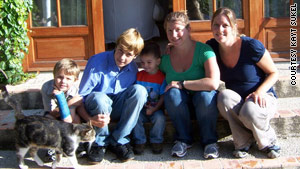 Staying with family
Staying with family can be a big plus, says Kayt Sukel. You save money; you and your kids get to spend quality time with your parents, siblings and in-laws.
It can also be a hassle.
"There has been tension," admits Sukel, a Texas-based freelance writer and contributor to the family travel blog Travelsavvymom.com, of the times she's stayed with relatives while traveling.
When the single mother and her young son have stayed with her sister's family in New Jersey, minor disputes have erupted.
"You've got guests waking up in the morning while some kids are still in school, other kids aren't, and you're saying, 'Do we have any food?' " she laughs.
"She has a three-ring circus going on, which I think any modern family sort of does," she adds. "And inserting guests into that, especially guests who are going to be there for awhile -- I'm amazed she hasn't banned us from the house, because it would make her life a lot easier."
The key, she says, is communicating.
"You have to respect that you're a guest, but I think that you have to be clear that this is a trip with dual purposes -- yes we want to see you, but we're also going to do some of these other things, too," she says. "Communication is a big, big thing."
Indeed, communication is at the heart of any family lodging arrangement, says social psychologist Susan Newman, author of "Under One Roof Again: All Grown Up and (Re)learning to Live Together Happily." Both guest and host should be supportive of one another and not lapse into old roles.
"It's a good idea to talk," she says. "Bringing issues up (in advance) will help immensely. ... You really want to be aware of falling back into parent-child mode" or reliving old sibling rivalries.
"Many parents don't realize they're trying to take control -- it's a pattern from all the years of raising you."
Which doesn't mean that children should flout their parents' authority, she says. Children may have moved away from mom and dad's religious beliefs or changed their eating habits, but when under someone else's roof, they should be considerate of their host.
In the case of Suzette Mack, a San Jose, California-based travel adviser and blogger of Adventures for Families, that meant separate sleeping arrangements before she was married.
"My husband and I would go back and visit family members and we abided by the rules of the house," she says. "We just did it out of respect. It wasn't even a big controversy or anything."
Sometimes family doesn't give you a choice of where to stay, says Sukel, no matter how inconvenient. Indeed, in some cultures it's an insult to look elsewhere; in Germany, Sukel says, it would be unthinkable to stay at a hotel if family or friends are nearby.
Which brings up another piece of advice: Always have an exit strategy.
"Don't rely on other people for your freedom," she says. "You're saving a couple hundred bucks a night on a hotel room? That means get the rental car. Make sure you have your own way of getting around, because that's probably the biggest thing you'll end up fighting about -- and it's the last thing you want to deal with especially with cranky kids or cranky grandparents."
Above all, says Mack, be aware that you're a guest. Pitch in with chores. Include the entire crew on an outing. Buy a tank of gas. If your host turns you down -- you're family, after all -- find a quiet way of doing something nice.
"Think about how much of a burden it is for your host," Mack says.
Traveling with parents
Ilana Glazer is a 24-year-old writer and comedian with a thick New York accent and a habit of sprinkling curse words in every other sentence.
She's also a softie who made an important discovery about her parents when she decided to take a recent vacation with them.
"They're sick," she says jokingly. "They have a sick relationship. They are soooo happy together."
The single adult who is dragged off to vacations with the parents is a stock character in movies and short stories. While Glazer's parents won't allow her to play that part, many adults find themselves slipping back into the parent-child roles they had growing up, psychologist Newman said.
If ancient history rears up, Newman suggests reminding your parents that you've been living on your own for years and you're not the same person anymore. Focus on the positives about your parents and don't have unrealistic expectations for flawless family fun, she says.
Glazer says she doesn't feel awkward or bored when vacationing with her parents. She's inspired.
"They're like each other's first true love," she says.
Glazer's father, Larry, works in insurance and finance. Her mother, Sandi, works with him. Both met in 1976 when her father, then a skinny, bearded college undergrad with curly hair, was introduced to her mother.
When Glazer recently vacationed with her parents at their Long Island, New York, home, she realized she didn't just love them. She also liked them.
Not every family trip is chock full of positive feelings. Steer clear of hot topics or pleasantly say "let's not go there," if a tense subject comes up, Newman advises. And if money is an issue, offer to contribute what you can, she says.
Glazer says her relationship with her parents wasn't always so inspired. She was a tomboy teenager who was socially awkward and depressed.
She turned away from the warmth of her parents' relationship and absorbed her adolescent angst. Glazer says she never liked the idea that parents should be their children's buddies. She wasn't going to open up too much to her parents.
"I didn't want them to be my best friends," she says. "I wanted them to be my mom and dad. They're best at that."
Glazer's brother, Eliot, was so inspired by his parents that he recently wrote a book, "My Parents Were Awesome," based on a blog that he created.
Of course, even Ilene's interactions with her parents aren't all great. While on vacation, she has asked her parents for dating advice about men. Unfortunately for her, their experience with dysfunctional romantic relationships is limited.
She had to tell them something that few parents ever hear:
And then, there's the reality.
Those adorable kids? Fighting in the back seat. Mom is weary, dad upset. The car, loaded down with luggage, electronics, junk food, cheap paperbacks and undisposed trash, feels smaller than an '64 Beetle and smells like a rest-stop bathroom. The airport is an endless hassle. And vacations, to be enjoyed by the whole family, turn into maddeningly hellish experiences.
It was perhaps best captured in the 1983 movie "National Lampoon's Vacation," which follows the all-American Griswolds as they drive the family station wagon on a cross-country trip to visit the Walley World theme park.
The Griswolds of "National Lampoon's Vacation" may be fictional, but some of their experiences are all too familiar.
Clark mashes the brakes. "I think you're all f---ed in the head," he says, before declaring they will have fun whether they want to or not. "This is no longer a vacation. It's a quest, it's a quest for fun!"
How can you cope?
As we head into the summer travel season, here are some tricks of the trade.
Planning for children
Even on road trips to Kansas City, a three-hour drive from their Omaha, Nebraska, home, Aaron and Virginia Ripley use strategic planning to mitigate the suffering of their three kids.
"We always plan our leaving times around nap times," says Aaron, a stay-at-home dad who has a 6-year-old, 4-year-old and 22-month-old. "We time it so that we drive for an hour, and they conk out for the rest."
The Ripleys go to Kansas City often for Royals baseball games and to see friends, but they also like to venture farther afield, aspiring to visit all 50 states with their kids by the time they graduate high school.
And on those longer trips, they get even more strategic about maintaining their kids' normal routines.
Aaron and Virginia Ripley plan carefully before traveling with their three young children.
"By avoiding hotels, we don't have to worry about going out to eat with the kids -- we can just stock up at the grocery store," says Aaron, 37. "The kids are able to keep their normal sleep routines because there are separate bedrooms."
Plus, the rental route saves the Ripleys cash. Rather than shelling out $200 a night on a hotel, like they did when it was just the two of them, the Ripleys have grown accustomed to paying around $1,000 for a week for a vacation rental. His wife finds and books the properties through VRBO.com.
Such habits suggest that the Ripleys have mastered what parenting experts say are keys to happy travel with young kids: advance planning and a recognition of children's limits.
"When traveling, you're really at the mercy of your child's pace," says Dana Points, editor-in-chief of Parents magazine. "You can't push them beyond what they can sustain. Adults can go a long time without getting rest or sleep. Kids can't."
Still, parents can help kids push their travel limits by packing plenty of snacks and games for long trips.
Points recommends surprising a child with a new toy on a long flight. "It's a distraction, pure and simple," she says. "People like shiny, new things."
At the same time, any extra baggage -- plus equipment and supplies such as strollers and diapers -- can add up pretty quickly, which is why many parents prefer to buy, borrow or rent as much gear as possible at their vacation destinations.
Or you can take a tip from the Ripleys' playbook and travel exclusively on Southwest Airlines, which doesn't charge passengers for extra bags.
If all that planning can seem overwhelming, Points says it's essential for traveling parents to maintain a sense of humor -- and to surrender some control. Flights will be delayed. Car tires will go flat.
"A lot of problems people associate with traveling with children is really more about the adults' anxiety," says Points, who has two sons, ages 7 and 9. "The kids aren't bothered by running around and screaming in a long security line at the airport. It's the adult that feels uncomfortable."
"You have to let go of thinking that everybody is judging you because you're not able to calm your kid," she says. "As long as everyone's safe, you're fine."
Dealing with teenagers
The spring of 2006 is when vacations "just got mindboggling bad" for Mary Treybig of Texas.
That's when her two sons, 13 and 15, drove her batty. They went for a weeklong skiing trip in Idaho. The summer before, they had a wonderful trip there. Yet this time, it was "no this, no that."
"It was endless. Everything was negative," she says. "They know how to make you miserable."
After that trip, she "wasn't going to take any more vacations with children who didn't want to go." She and her husband would plan trips; the kids would reject them. So, the couple hired a sitter and hit the road without their two sons.
It was cheaper and more enjoyable. Sans kids, she and her husband traveled to Grand Cayman, Belize and twice to Honduras over the next four years.
"We felt really guilty the first time we left them," she says. "Then, we realized, 'Wow, this is so much fun!' "
It was also a lesson for her children, she says, teaching them that actions have consequences.
For any parent going through this experience, Treybig says, there is a "light at the end of that tunnel." Her kids have matured and moved out of that phase. Last summer, they had a wonderful family vacation to Cozumel. They plan to return in a couple weeks.
"We're better now. We're having fun again."
Dr. Arthur Bodin, a past president of the Society for Family Psychology, a division of the American Psychological Association, says it's perfectly common for teens to not want to go on family vacations.
But he suggests four steps that can help:
-- Have a family conference in which everyone participates in planning where to go and what to do.
-- Have some sort of rotation on the vacation decision-making. Some of the time the parents decide, some of the time the kids decide (and within that option, there can be some turn-taking among the children).
-- Cater to the adults for part of the trip, and cater to the children's wishes for another portion of the vacation.
-- Allow each child to invite a friend along.
Still, there are no guarantees, Bodin says.
"The concern of some parents may be heightened by their feeling hurt or rejected by their children not wanting to be part of a family vacation. It may help the parents if they recognize in their children's reluctance an age-appropriate striving toward independence."
For most children, he says, "it's a natural phase that they go through."
"I don't want to imply that it's a disease if your children don't want to come with you," adds Bodin, a psychologist practicing in Palo Alto, California, and a senior research fellow at the Mental Research Institute there.
"For parents to fight it is like trying to hold back the tide. The four suggestions offered here are more like swimming with the tide."
Kayt Sukel, second from right, and son Chet, center, occasionally stay with Sukel's sister Lisa Schill and Schill's family.
Staying with family can be a big plus, says Kayt Sukel. You save money; you and your kids get to spend quality time with your parents, siblings and in-laws.
It can also be a hassle.
"There has been tension," admits Sukel, a Texas-based freelance writer and contributor to the family travel blog Travelsavvymom.com, of the times she's stayed with relatives while traveling.
When the single mother and her young son have stayed with her sister's family in New Jersey, minor disputes have erupted.
"You've got guests waking up in the morning while some kids are still in school, other kids aren't, and you're saying, 'Do we have any food?' " she laughs.
"She has a three-ring circus going on, which I think any modern family sort of does," she adds. "And inserting guests into that, especially guests who are going to be there for awhile -- I'm amazed she hasn't banned us from the house, because it would make her life a lot easier."
The key, she says, is communicating.
"You have to respect that you're a guest, but I think that you have to be clear that this is a trip with dual purposes -- yes we want to see you, but we're also going to do some of these other things, too," she says. "Communication is a big, big thing."
Indeed, communication is at the heart of any family lodging arrangement, says social psychologist Susan Newman, author of "Under One Roof Again: All Grown Up and (Re)learning to Live Together Happily." Both guest and host should be supportive of one another and not lapse into old roles.
"It's a good idea to talk," she says. "Bringing issues up (in advance) will help immensely. ... You really want to be aware of falling back into parent-child mode" or reliving old sibling rivalries.
"Many parents don't realize they're trying to take control -- it's a pattern from all the years of raising you."
Which doesn't mean that children should flout their parents' authority, she says. Children may have moved away from mom and dad's religious beliefs or changed their eating habits, but when under someone else's roof, they should be considerate of their host.
In the case of Suzette Mack, a San Jose, California-based travel adviser and blogger of Adventures for Families, that meant separate sleeping arrangements before she was married.
"My husband and I would go back and visit family members and we abided by the rules of the house," she says. "We just did it out of respect. It wasn't even a big controversy or anything."
Sometimes family doesn't give you a choice of where to stay, says Sukel, no matter how inconvenient. Indeed, in some cultures it's an insult to look elsewhere; in Germany, Sukel says, it would be unthinkable to stay at a hotel if family or friends are nearby.
Which brings up another piece of advice: Always have an exit strategy.
"Don't rely on other people for your freedom," she says. "You're saving a couple hundred bucks a night on a hotel room? That means get the rental car. Make sure you have your own way of getting around, because that's probably the biggest thing you'll end up fighting about -- and it's the last thing you want to deal with especially with cranky kids or cranky grandparents."
Above all, says Mack, be aware that you're a guest. Pitch in with chores. Include the entire crew on an outing. Buy a tank of gas. If your host turns you down -- you're family, after all -- find a quiet way of doing something nice.
"Think about how much of a burden it is for your host," Mack says.
Ilana Glazer was "inspired" after traveling with her parents (above), Sandi and Larry.
Ilana Glazer is a 24-year-old writer and comedian with a thick New York accent and a habit of sprinkling curse words in every other sentence.
She's also a softie who made an important discovery about her parents when she decided to take a recent vacation with them.
"They're sick," she says jokingly. "They have a sick relationship. They are soooo happy together."
The single adult who is dragged off to vacations with the parents is a stock character in movies and short stories. While Glazer's parents won't allow her to play that part, many adults find themselves slipping back into the parent-child roles they had growing up, psychologist Newman said.
If ancient history rears up, Newman suggests reminding your parents that you've been living on your own for years and you're not the same person anymore. Focus on the positives about your parents and don't have unrealistic expectations for flawless family fun, she says.
Glazer says she doesn't feel awkward or bored when vacationing with her parents. She's inspired.
"They're like each other's first true love," she says.
Glazer's father, Larry, works in insurance and finance. Her mother, Sandi, works with him. Both met in 1976 when her father, then a skinny, bearded college undergrad with curly hair, was introduced to her mother.
When Glazer recently vacationed with her parents at their Long Island, New York, home, she realized she didn't just love them. She also liked them.
Not every family trip is chock full of positive feelings. Steer clear of hot topics or pleasantly say "let's not go there," if a tense subject comes up, Newman advises. And if money is an issue, offer to contribute what you can, she says.
Glazer says her relationship with her parents wasn't always so inspired. She was a tomboy teenager who was socially awkward and depressed.
She turned away from the warmth of her parents' relationship and absorbed her adolescent angst. Glazer says she never liked the idea that parents should be their children's buddies. She wasn't going to open up too much to her parents.
"I didn't want them to be my best friends," she says. "I wanted them to be my mom and dad. They're best at that."
Glazer's brother, Eliot, was so inspired by his parents that he recently wrote a book, "My Parents Were Awesome," based on a blog that he created.
Of course, even Ilene's interactions with her parents aren't all great. While on vacation, she has asked her parents for dating advice about men. Unfortunately for her, their experience with dysfunctional romantic relationships is limited.
She had to tell them something that few parents ever hear:
"You're both so perfect. You don't get it."
CNN's Dan Gilgoff, Wayne Drash, Todd Leopold and John Blake contributed to this article.
Friday, May 27, 2011
Why you should visit a new destination
Time flies when you're having fun on holiday, right? Well, maybe it shouldn't. That's not to say your vacation should drag in a dull, five-hour bio-documentary type way. Just that "going local" in a new place -- the more "exotic" the better -- is literally more memorable, and feels longer, than a seventh straight visit to Uncle Todd's lake house.
My gut experience tells me that, but science backs up the notion too. David Eagleman, a neuroscience professor at the Baylor College of Medicine in Houston, has written that our perception of time quickens with age, because adults tend to have "compressed" memories. But, Eagleman agrees, travel to "novel places" is an equalizer.
"It essentially puts you -- neurally -- in the same position as when you were a child," he told me by e-mail.
So, travel to a new place makes you a kid again? That sounds like encouraging news, particularly for Americans. U.S. jobs come with relatively less vacation time than many nations, and Americans often make repeat visits to places we've already enjoyed.
Why is America the 'no-vacation nation'?
For example, about nine in 10 of Florida's annual 80 million annual visitors have been before. Sure, its beaches (and amusement parks) are great, but we benefit if we mix it up some.
One overlooked alternative is a study-abroad vacation, which is as suitable for long-term university students as for families trying to fill a couple weeks in August.
Consider studying Spanish in a place like Latin America's loveliest colonial town, Antigua, Guatemala, where it's possible to arrange private classes, homestays with local families and side trips to volcanoes and timeless Mayan villages. That's some rewarding immersion, for about $125 per person, per week.
Why your brain needs vacations
You can get a lot out of place in a short time by filling it with new, varied activities. Last winter I visited Quebec City, a fortified Canadian city that can feel like a trip to France without the jetlag.
In one day, I got a free curling lesson from a moustached Quebecois man, saw a dogsled race on snowy 400-year-old lanes, ate a juicy caribou steak in one of the continent's oldest restaurants, watched boites a chansons (local folk music) shows with hipster locals and yelled "allez allez" at a wild minor-league hockey game. Yep, that was a whirwind day, a memorable one.
And it's not just new experiences found on the road, but what you bring back.
William Maddux, an American social psychologist at the INSEAD research center in France, studies how living abroad makes one more creative.
The key, he says, is not just being in different cultures, but being open to immersion: learning the language, adapting to an alternate way of life.
"We're finding that people walking around with two types of cultures in their heads approach solutions more creatively," Maddux told me by phone.
That's the same sentiment from this 2009 TED video, in which graphic-designer Stefan Sagmeister explains he takes a one-year sabbatical every seven years to experiment and churn out fresher, more original ideas for work.
This doesn't mean you have to leave the USA. Savannah or South Dakota can feel more exotic to a New Yorker than, say, Toronto or London. And vice versa.
You can also mingle with communities well outside your norm. A good opportunity these days is among all those bearded re-enactors at an event commemorating the 150th anniversary of the Civil War.
A couple years ago, I spent an eye-opening afternoon at the "rebel camp" at Gettysburg trying to learn how they decide who "dies" first during mock battles. (I had a great time, but discovered it's utter chaos that determines their "casualty" order.)
Lonely Planet: How do Civil War re-enactors decide who dies first?
Not everyone wants the same things from travel. Sometimes there's nothing better than doing nothing on a beach for a week. That's fine, even healthy.
Still I think we need a new travel rule: go to at least one new place every three years.
That way, we can stretch the perceived time of our vacations, expand our memories in a youthful-like way, and return home with more creative ideas.
My gut experience tells me that, but science backs up the notion too. David Eagleman, a neuroscience professor at the Baylor College of Medicine in Houston, has written that our perception of time quickens with age, because adults tend to have "compressed" memories. But, Eagleman agrees, travel to "novel places" is an equalizer.
"It essentially puts you -- neurally -- in the same position as when you were a child," he told me by e-mail.
Why is America the 'no-vacation nation'?
For example, about nine in 10 of Florida's annual 80 million annual visitors have been before. Sure, its beaches (and amusement parks) are great, but we benefit if we mix it up some.
One overlooked alternative is a study-abroad vacation, which is as suitable for long-term university students as for families trying to fill a couple weeks in August.
Consider studying Spanish in a place like Latin America's loveliest colonial town, Antigua, Guatemala, where it's possible to arrange private classes, homestays with local families and side trips to volcanoes and timeless Mayan villages. That's some rewarding immersion, for about $125 per person, per week.
Why your brain needs vacations
You can get a lot out of place in a short time by filling it with new, varied activities. Last winter I visited Quebec City, a fortified Canadian city that can feel like a trip to France without the jetlag.
In one day, I got a free curling lesson from a moustached Quebecois man, saw a dogsled race on snowy 400-year-old lanes, ate a juicy caribou steak in one of the continent's oldest restaurants, watched boites a chansons (local folk music) shows with hipster locals and yelled "allez allez" at a wild minor-league hockey game. Yep, that was a whirwind day, a memorable one.
And it's not just new experiences found on the road, but what you bring back.
William Maddux, an American social psychologist at the INSEAD research center in France, studies how living abroad makes one more creative.
The key, he says, is not just being in different cultures, but being open to immersion: learning the language, adapting to an alternate way of life.
"We're finding that people walking around with two types of cultures in their heads approach solutions more creatively," Maddux told me by phone.
That's the same sentiment from this 2009 TED video, in which graphic-designer Stefan Sagmeister explains he takes a one-year sabbatical every seven years to experiment and churn out fresher, more original ideas for work.
This doesn't mean you have to leave the USA. Savannah or South Dakota can feel more exotic to a New Yorker than, say, Toronto or London. And vice versa.
You can also mingle with communities well outside your norm. A good opportunity these days is among all those bearded re-enactors at an event commemorating the 150th anniversary of the Civil War.
A couple years ago, I spent an eye-opening afternoon at the "rebel camp" at Gettysburg trying to learn how they decide who "dies" first during mock battles. (I had a great time, but discovered it's utter chaos that determines their "casualty" order.)
Lonely Planet: How do Civil War re-enactors decide who dies first?
Not everyone wants the same things from travel. Sometimes there's nothing better than doing nothing on a beach for a week. That's fine, even healthy.
Still I think we need a new travel rule: go to at least one new place every three years.
That way, we can stretch the perceived time of our vacations, expand our memories in a youthful-like way, and return home with more creative ideas.
Plus, we'll know more of what we've been missing.
Thursday, May 26, 2011
Five places for Chocolate Lover's
Traveling to beautiful places is already sweet, but the journeys can get decadent if you succumb to the power of chocolate.
Chocolate tourism is big, as luscious bonbons, pralines, pastries, cakes, cookies, mousses and other delights have chocoholics all over the world craving classes and museums devoted to the heavenly food.
You probably already know about Hershey, Pennsylvania; Ghirardelli Square in San Francisco; and other destinations for chocolate-lovers closer to home.
Here are five more options in Europe.
Eurochocolate Festival and Casa Del Cioccolato -- Perugia, Italy
Come to Perugia to celebrate Italy's chocolate tradition in a big way. The annual Eurochocolate Festival in the city's historic center, scheduled to take place this year from October 14 to 23, features chocolate pasta, chocolate salami and other whimsical creations from chefs and confectioners.
"This is heaven for chocolate lovers," Frommer's promises. "This event promises to fulfill even the most insatiable craving."
You can also admire huge, edible sculptures carved out of chocolate blocks -- the festival recently featured a chocolate igloo made out of almost 8,000 pounds of the sweet stuff.
Visitors get to munch on the chocolate shavings produced during the creation of the sculptures.
YouTube: A tasty tour of the chocolate festival
Perugia is also home to Perugina -- the maker of Baci chocolates -- and a short taxi ride from the heart of the city will take you to the Perugina Casa Del Cioccolato (House of Chocolate). There, you can explore the Perugina Museum and tour the sweet-smelling factory where the Baci take shape.
Perugina allows visitors to become chocolatiers for a day by taking courses offered by its Chocolate School.
Complete your experience by staying at the Etruscan Chocohotel, which bills itself as the first hotel in the world dedicated to chocolate.
Chocolate tours -- Brussels, Belgium
You can't escape it -- chocolate looms large pretty much anywhere you go in the city, and that's a good thing.
First, some sweet statistics: Belgium produces 172,000 tons of chocolate per year and is home to more than 2,000 chocolate shops throughout the country, according to the Belgium Tourism Office.
Many of them are located in Brussels -- this is where Godiva chocolate began -- and visitors can choose from a number of tours that take them to chocolate-making demonstrations, workshops and tastings.
Here is one sample itinerary, billed as "the ultimate chocolate indulgence walk": Learn how to make your own pralines, spend some time with a chocolate master, try unusual flavor combinations and visit famous chocolate boutiques.
You can find a comprehensive list of the tours at visitbelgium.com.
Chocolate Museum -- Cologne, Germany
All you ever wanted to know about chocolate should be inside this unique building located next to Cologne's Old Town.
There are three exhibition levels for chocoholics to enjoy. The first features a greenhouse where cocoa trees grow (they require a humid environment and an average temperature between 77 and 82 degrees Fahrenheit) and a small chocolate factory that shows visitors how chocolate bars, hollow figures and pralines are made.
The second level explains the history of chocolate, which began with ancient American cultures 3,000 years ago. The Maya and Aztec civilizations used cocoa both as medicine and a means of payment, the museum says, while the first evidence of chocolate in Europe showed up in 1544.
The third level is all about chocolate products, including a closer look at some of the biggest names in the industry, a timeline of chocolate advertising and movies on the sweet subject shown in a "chocolate cinema."
End your tour with a treat from the museum's café, which tempts visitors with cakes and drinking chocolates.
For more information, visit www.chocolatemuseum-cologne.com
Chocolate train -- Switzerland
Cheese, chocolate and gorgeous scenery -- what's not to love?
You board the train in Montreaux, Switzerland, then head to Gruyeres, home to the famous cheese that's used in fondues and melted on top of French onion soup. This part of the journey includes a visit to a cheesemaking factory and a tour of Gruyeres Castle.
Next stop: the idyllic town of Broc and a visit to the Cailler-Nestle chocolate factory, where you can indulge in samples and take in the beautiful of views of Lake Gruyeres and the Alps.
The factory was opened in 1989 by the grandson of François-Louis Cailler, who brought the first chocolate recipe to Switzerland in 1819, according to the company.
This daylong excursion runs Monday through Friday during July and August, and on Mondays, Wednesdays and Thursdays in June, September and October.
Harrods Chocolate Bar -- London
The famous department store calls this eatery a "chocoholic's fantasy come true." Visitors will find melting chocolate fountains and a selection of hot, cold and alcoholic drinks made with the sweet stuff, like dark chocolate martinis.
Hungry? The menu features cakes, muffins, crepes, brownies and other tempting desserts, including chocolate fondue, molten lava chocolate cake and chocolate waffles.
For a luxurious touch, you can try strawberries served with chocolate dip and a flute of champagne. Or go for the chocolate ice cream with the hot chocolate topping.
Chocolate tourism is big, as luscious bonbons, pralines, pastries, cakes, cookies, mousses and other delights have chocoholics all over the world craving classes and museums devoted to the heavenly food.
You probably already know about Hershey, Pennsylvania; Ghirardelli Square in San Francisco; and other destinations for chocolate-lovers closer to home.
Here are five more options in Europe.
Eurochocolate Festival and Casa Del Cioccolato -- Perugia, Italy
Come to Perugia to celebrate Italy's chocolate tradition in a big way. The annual Eurochocolate Festival in the city's historic center, scheduled to take place this year from October 14 to 23, features chocolate pasta, chocolate salami and other whimsical creations from chefs and confectioners.
"This is heaven for chocolate lovers," Frommer's promises. "This event promises to fulfill even the most insatiable craving."
You can also admire huge, edible sculptures carved out of chocolate blocks -- the festival recently featured a chocolate igloo made out of almost 8,000 pounds of the sweet stuff.
Visitors get to munch on the chocolate shavings produced during the creation of the sculptures.
YouTube: A tasty tour of the chocolate festival
Perugia is also home to Perugina -- the maker of Baci chocolates -- and a short taxi ride from the heart of the city will take you to the Perugina Casa Del Cioccolato (House of Chocolate). There, you can explore the Perugina Museum and tour the sweet-smelling factory where the Baci take shape.
Perugina allows visitors to become chocolatiers for a day by taking courses offered by its Chocolate School.
Complete your experience by staying at the Etruscan Chocohotel, which bills itself as the first hotel in the world dedicated to chocolate.
Chocolate tours -- Brussels, Belgium
You can't escape it -- chocolate looms large pretty much anywhere you go in the city, and that's a good thing.
First, some sweet statistics: Belgium produces 172,000 tons of chocolate per year and is home to more than 2,000 chocolate shops throughout the country, according to the Belgium Tourism Office.
Many of them are located in Brussels -- this is where Godiva chocolate began -- and visitors can choose from a number of tours that take them to chocolate-making demonstrations, workshops and tastings.
Here is one sample itinerary, billed as "the ultimate chocolate indulgence walk": Learn how to make your own pralines, spend some time with a chocolate master, try unusual flavor combinations and visit famous chocolate boutiques.
You can find a comprehensive list of the tours at visitbelgium.com.
Chocolate Museum -- Cologne, Germany
All you ever wanted to know about chocolate should be inside this unique building located next to Cologne's Old Town.
There are three exhibition levels for chocoholics to enjoy. The first features a greenhouse where cocoa trees grow (they require a humid environment and an average temperature between 77 and 82 degrees Fahrenheit) and a small chocolate factory that shows visitors how chocolate bars, hollow figures and pralines are made.
The second level explains the history of chocolate, which began with ancient American cultures 3,000 years ago. The Maya and Aztec civilizations used cocoa both as medicine and a means of payment, the museum says, while the first evidence of chocolate in Europe showed up in 1544.
The third level is all about chocolate products, including a closer look at some of the biggest names in the industry, a timeline of chocolate advertising and movies on the sweet subject shown in a "chocolate cinema."
End your tour with a treat from the museum's café, which tempts visitors with cakes and drinking chocolates.
For more information, visit www.chocolatemuseum-cologne.com
Chocolate train -- Switzerland
Cheese, chocolate and gorgeous scenery -- what's not to love?
You board the train in Montreaux, Switzerland, then head to Gruyeres, home to the famous cheese that's used in fondues and melted on top of French onion soup. This part of the journey includes a visit to a cheesemaking factory and a tour of Gruyeres Castle.
Next stop: the idyllic town of Broc and a visit to the Cailler-Nestle chocolate factory, where you can indulge in samples and take in the beautiful of views of Lake Gruyeres and the Alps.
The factory was opened in 1989 by the grandson of François-Louis Cailler, who brought the first chocolate recipe to Switzerland in 1819, according to the company.
This daylong excursion runs Monday through Friday during July and August, and on Mondays, Wednesdays and Thursdays in June, September and October.
Harrods Chocolate Bar -- London
The famous department store calls this eatery a "chocoholic's fantasy come true." Visitors will find melting chocolate fountains and a selection of hot, cold and alcoholic drinks made with the sweet stuff, like dark chocolate martinis.
Hungry? The menu features cakes, muffins, crepes, brownies and other tempting desserts, including chocolate fondue, molten lava chocolate cake and chocolate waffles.
For a luxurious touch, you can try strawberries served with chocolate dip and a flute of champagne. Or go for the chocolate ice cream with the hot chocolate topping.
Then go for a nap. Sweet dreams.
10 natural wonders to see before they disappear .. .. ..
BELIZE BARRIER REEF
Like the Great Barrier Reef in Australia, the Belize Barrier Reef leads a tenuous existence.
A section of the nearly 700-mile-long Mesoamerican Reef that reaches from Mexico to Honduras, the Belize reef suffered a severe bleaching in 1998, with a loss of 50 percent of its coral in many areas, including much of its distinctive staghorn coral.
Since the bleaching, its decline has continued, due to global warming of the world's seas, agricultural pollution, development, and increasing tourism, which has given rise to more coastal development and an invasion of cruise ships.
THE CONGO BASIN
At more than 1.3 million square miles, the Congo Basin has the world's second-largest rainforest, after the Amazon's. According to the United Nations, up to two-thirds of the forest and its unique plants and wildlife could be lost by 2040 unless more effective measures are taken to protect it.
Extending across six nations, ten million acres of forest is degraded each year due to mining, illegal logging, farming, ranching, and guerilla warfare. Roads cut by loggers and miners have also enabled poachers and bushmeat hunters to prey on endangered animals like mountain gorillas, forest elephants, bonobos, and okapis.
As the forest shrinks, less carbon dioxide is absorbed, and rain decreases, adding to climate change.
THE DEAD SEA
In the last four decades, the Dead Sea has shrunk by a third and sunk 80 feet --13 inches per year! -- stranding formerly seaside resorts and restaurants nearly a mile from shore.
The Jordan River is the lake's sole source, and as surrounding countries increasingly tap its waters, little reaches the Dead Sea, which could disappear within 50 years. Further pressure is put on the sea by the cosmetic companies and potash producers who drain it for minerals.
One proposed solution is the controversial Red-Dead Canal, channeling water 112 miles from the Red Sea, but its environmental impact could be negative (some worry that it would increase seismic activity in the region).
THE EVERGLADES
A host of dangers are putting this fragile wetland at risk: pollution from farms, invasive species, and encroaching development, not to mention the fact that 60 percent of the region's water is being diverted to nearby cities and farms.
As a result, The Everglades is now half the size it was in 1900. Worse, this is the sole habitat of the Florida panther, and there are less than 100 of the creatures left in the wild.
These big cats may be completely lost within the next 40 years as their habitat disappears (they're not alone, either -- at least 20 species in the Everglades are endangered, including turtles, manatees, and wading birds).
MADAGASCAR
If nothing is done to save the world's fourth-largest island, its forests will be gone in 35 years (once 120,000 square miles, they're now down to 20,000), and their unique inhabitants along with them.
Forest ecosystems are being destroyed by logging, burning for subsistence farms, and poaching. The 20 species of lemurs for which Madagascar is renowned are in danger of disappearing.
Though there are game reserves, they're not large (occupying only 5% of the island), nor are they contiguous, thus failing to provide corridors for the animals to travel through. Some of Madagascar's endemic species have never even been recorded, and will likely be lost before they can be studied.
THE MALDIVES
Few scientists hold out much hope for the Maldives -- the world's lowest nation -- if global warming continues to melt the ice caps and raise sea levels. Its 1,190 small islands and atolls (200 of which are inhabited) scattered across the Indian Ocean rise a mere eight feet above sea level.
In 2008, the President of the Maldives announced the government would start buying land in other countries, including India, for future homes for citizens displaced by rising waters. In 2009, he held a cabinet meeting underwater to stress the islands' vulnerability.
THE POLES
The Woods Hole Oceanographic Institute, the world's largest non-profit ocean research group, has predicted that 80 percent of the emperor penguin population of Antarctica will be lost, and the rest in danger of extinction, if global warming continues.
In the Arctic, the polar bear is also endangered by the steady loss of sea ice (which has decreased 3% per decade since the 1970s). As sea ice disappears at the poles, so do entire ecosystems: the phytoplankton that grows under ice sheets feeds zooplankton and small crustaceans like krill, which are on the food chain for fish, seals, whales, polar bears and penguins.
Studies predict that with continued warming, within 20-40 years, no ice will form in Antarctica.
RAJASTHAN, RANTHAMBORE
The world's population of wild tigers has fallen to as few as 3,200, more than half of which live in India. If extreme efforts are not undertaken, the big cat may be extinct within our lifetime -- possibly in as soon as a dozen years. (Compare this number to the 100,000 tigers that lived in India in 1900 and you can see just how drastically things have changed in the past two centuries.)
Their habitats have been reduced 93%, and though there are reserves across Asia, most are small and have no corridors between them for the normally far-roaming felines. It's estimated that a tiger a day is killed for use in Chinese traditional medicine.
THE TAHUAMANÚ RAINFOREST
This magnificent rain forest in Peru's Madre de Dios region holds some of the last old-growth stands of mahogany in South America. But illegal logging is depleting the rainforest -- and the U.S. is responsible for buying 80% of the mahogany.
A single tree can create as much as $1 million worth of furniture. Loggers build roads, allowing farmers and hunters to enter, further crowding the indigenous people and destroying the delicate ecosystem. In nearby areas, gold mining has released mercury into the air and water.
THE YANGTZE RIVER BASIN
It's too early to know the exact impact of the creation of China's massive, $24 billion Three Gorges Dam, but many, including the Chinese government, have acknowledged that the Yangtze Basin region is in danger of losing its most distinctive marine and animal life.
Deforestation has occurred from clearing land for displaced farmers, and the reservoir has flooded villages, farms, factories, and mines, adding to the Yangtze River's existing pollution from shipping, industry, agriculture and raw sewage.
Like the Great Barrier Reef in Australia, the Belize Barrier Reef leads a tenuous existence.
A section of the nearly 700-mile-long Mesoamerican Reef that reaches from Mexico to Honduras, the Belize reef suffered a severe bleaching in 1998, with a loss of 50 percent of its coral in many areas, including much of its distinctive staghorn coral.
Since the bleaching, its decline has continued, due to global warming of the world's seas, agricultural pollution, development, and increasing tourism, which has given rise to more coastal development and an invasion of cruise ships.
THE CONGO BASIN
At more than 1.3 million square miles, the Congo Basin has the world's second-largest rainforest, after the Amazon's. According to the United Nations, up to two-thirds of the forest and its unique plants and wildlife could be lost by 2040 unless more effective measures are taken to protect it.
Extending across six nations, ten million acres of forest is degraded each year due to mining, illegal logging, farming, ranching, and guerilla warfare. Roads cut by loggers and miners have also enabled poachers and bushmeat hunters to prey on endangered animals like mountain gorillas, forest elephants, bonobos, and okapis.
As the forest shrinks, less carbon dioxide is absorbed, and rain decreases, adding to climate change.
THE DEAD SEA
In the last four decades, the Dead Sea has shrunk by a third and sunk 80 feet --13 inches per year! -- stranding formerly seaside resorts and restaurants nearly a mile from shore.
The Jordan River is the lake's sole source, and as surrounding countries increasingly tap its waters, little reaches the Dead Sea, which could disappear within 50 years. Further pressure is put on the sea by the cosmetic companies and potash producers who drain it for minerals.
One proposed solution is the controversial Red-Dead Canal, channeling water 112 miles from the Red Sea, but its environmental impact could be negative (some worry that it would increase seismic activity in the region).
THE EVERGLADES
A host of dangers are putting this fragile wetland at risk: pollution from farms, invasive species, and encroaching development, not to mention the fact that 60 percent of the region's water is being diverted to nearby cities and farms.
As a result, The Everglades is now half the size it was in 1900. Worse, this is the sole habitat of the Florida panther, and there are less than 100 of the creatures left in the wild.
These big cats may be completely lost within the next 40 years as their habitat disappears (they're not alone, either -- at least 20 species in the Everglades are endangered, including turtles, manatees, and wading birds).
MADAGASCAR
If nothing is done to save the world's fourth-largest island, its forests will be gone in 35 years (once 120,000 square miles, they're now down to 20,000), and their unique inhabitants along with them.
Forest ecosystems are being destroyed by logging, burning for subsistence farms, and poaching. The 20 species of lemurs for which Madagascar is renowned are in danger of disappearing.
Though there are game reserves, they're not large (occupying only 5% of the island), nor are they contiguous, thus failing to provide corridors for the animals to travel through. Some of Madagascar's endemic species have never even been recorded, and will likely be lost before they can be studied.
THE MALDIVES
Few scientists hold out much hope for the Maldives -- the world's lowest nation -- if global warming continues to melt the ice caps and raise sea levels. Its 1,190 small islands and atolls (200 of which are inhabited) scattered across the Indian Ocean rise a mere eight feet above sea level.
In 2008, the President of the Maldives announced the government would start buying land in other countries, including India, for future homes for citizens displaced by rising waters. In 2009, he held a cabinet meeting underwater to stress the islands' vulnerability.
THE POLES
The Woods Hole Oceanographic Institute, the world's largest non-profit ocean research group, has predicted that 80 percent of the emperor penguin population of Antarctica will be lost, and the rest in danger of extinction, if global warming continues.
In the Arctic, the polar bear is also endangered by the steady loss of sea ice (which has decreased 3% per decade since the 1970s). As sea ice disappears at the poles, so do entire ecosystems: the phytoplankton that grows under ice sheets feeds zooplankton and small crustaceans like krill, which are on the food chain for fish, seals, whales, polar bears and penguins.
Studies predict that with continued warming, within 20-40 years, no ice will form in Antarctica.
RAJASTHAN, RANTHAMBORE
The world's population of wild tigers has fallen to as few as 3,200, more than half of which live in India. If extreme efforts are not undertaken, the big cat may be extinct within our lifetime -- possibly in as soon as a dozen years. (Compare this number to the 100,000 tigers that lived in India in 1900 and you can see just how drastically things have changed in the past two centuries.)
Their habitats have been reduced 93%, and though there are reserves across Asia, most are small and have no corridors between them for the normally far-roaming felines. It's estimated that a tiger a day is killed for use in Chinese traditional medicine.
THE TAHUAMANÚ RAINFOREST
This magnificent rain forest in Peru's Madre de Dios region holds some of the last old-growth stands of mahogany in South America. But illegal logging is depleting the rainforest -- and the U.S. is responsible for buying 80% of the mahogany.
A single tree can create as much as $1 million worth of furniture. Loggers build roads, allowing farmers and hunters to enter, further crowding the indigenous people and destroying the delicate ecosystem. In nearby areas, gold mining has released mercury into the air and water.
THE YANGTZE RIVER BASIN
It's too early to know the exact impact of the creation of China's massive, $24 billion Three Gorges Dam, but many, including the Chinese government, have acknowledged that the Yangtze Basin region is in danger of losing its most distinctive marine and animal life.
Deforestation has occurred from clearing land for displaced farmers, and the reservoir has flooded villages, farms, factories, and mines, adding to the Yangtze River's existing pollution from shipping, industry, agriculture and raw sewage.
Landslides have also happened, and seismologists wonder if the water pressure above two fault lines might result in a disastrous earthquake.
Subscribe to:
Posts (Atom)